



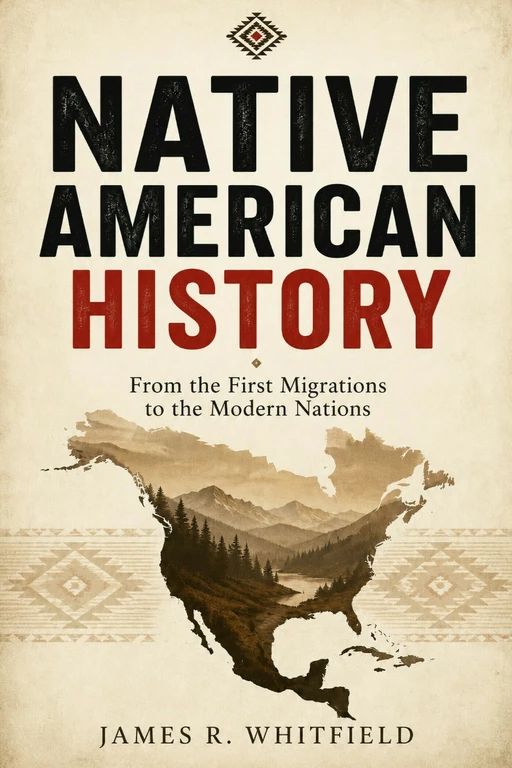
NATIVE AMERICAN HISTORY
Résumé
In the summer of 1908, a Black cowboy named George McJunkin noticed bones in a washed-out arroyo in New Mexico. Lodged among them was a fluted spear point between the ribs of an extinct bison. He died in 1922 before anyone took him seriously. Five years later, archaeologists confirmed what he understood: humans had hunted here for at least ten thousand years — and sites from Monte Verde to White Sands suggest twenty thousand or more.
That deep past is where this narrative history begins. James R. Whitfield traces the full arc from Cahokia — the pre-Columbian city that at its height rivaled London — through the Haudenosaunee Confederacy's federal constitution (some historians date it to 1142), the Pueblo Revolt of 1680, Sitting Bull's four years in Canadian exile, the 250-person massacre at Wounded Knee in December 1890, Richard Pratt's Carlisle boarding school with its motto "Kill the Indian, Save the Man," and the American Indian Movement's 71-day occupation of Wounded Knee in 1973.
Inside this Native American history book:• The deep precolonial past — Cahokia's Monks Mound, larger in footprint than any Egyptian pyramid; Chaco Canyon's lunar-standstill calendar; Hopewell trade networks from Lake Superior to the Gulf (Chapters 2-3)
• Haudenosaunee democracy — the Peacemaker's Great Law, five nations bound in a federal confederacy centuries before the U.S. Constitution (Chapter 4)
• Contact and catastrophe — a 90-percent population collapse within 150 years; disease traveling trade routes before Europeans arrived (Chapters 6-8)
• Trail of Tears and the wars of the West — Jackson's Removal Act, Sitting Bull's surrender and death at the hands of Lakota police, the Ghost Dance (Chapters 10-13)
• The boarding-school era — 408 federal schools, 53 burial sites, and intergenerational trauma documented in the 2022 Interior Department report (Chapter 14)
• Red Power — Alcatraz 1969, the Trail of Broken Treaties, the armed 71-day Wounded Knee siege of 1973 (Chapter 16)
• The living nations — tribal sovereignty, language immersion schools, and nine million Americans who identify as Native today (Chapters 17-18)
No other single-volume narrative covers fifteen thousand years of Indigenous North America — from Ice Age migrants to the self-determination era. The story did not end at Wounded Knee. It is still being written.
For readers of Roxanne Dunbar-Ortiz's AN INDIGENOUS PEOPLES' HISTORY OF THE UNITED STATES and Dee Brown's BURY MY HEART AT WOUNDED KNEE.
Caractéristiques
Publication : 2 juin 2026
Intérieur : Noir & blanc
Support(s) : eBook [ePub]
Contenu(s) : ePub
Protection(s) : Aucune (ePub)
Taille(s) : 860 ko (ePub)
Langue(s) : Anglais
EAN13 eBook [ePub] : 9798905168567
Avis
Ouvrages du même auteur
6,99 €
6,99 €

8,99 €
6,99 €
5,99 €