



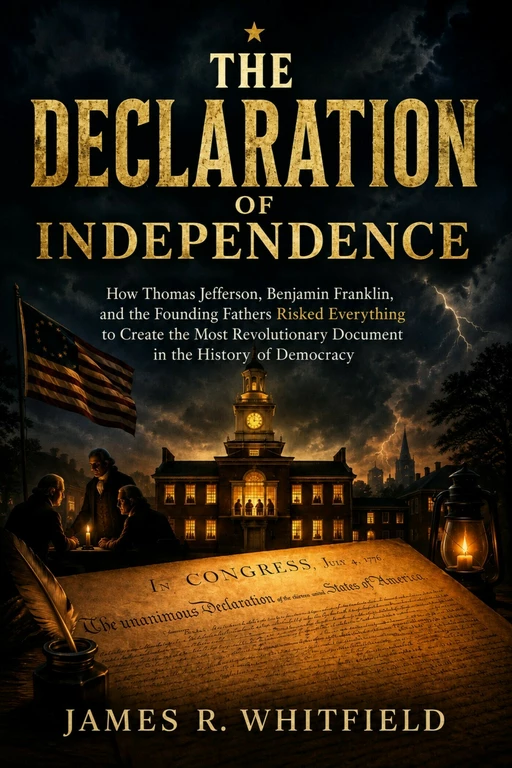
THE DECLARATION OF INDEPENDENCE
Résumé
The complete narrative history of the Declaration of Independence — Thomas Jefferson, Benjamin Franklin, John Adams, and how 56 signers risked their lives to produce the most revolutionary document in American history.On June 11, 1776, Thomas Jefferson sat at a portable writing desk — a fourteen-inch folding box he had designed himself — in a rented room at the corner of Market and Seventh Streets in Philadelphia. Over the next two weeks, drawing on John Locke, George Mason's Virginia Constitution draft, and his own 1774 pamphlet A Summary View, Jefferson produced a first draft that John Adams called the work of a man "ten times" the writer Adams himself was.This Declaration of Independence history traces the full arc of the founding document: the imperial crisis from the Proclamation of 1763 through Lexington and Concord, Jefferson's drafting sprint, Franklin's editorial hand that changed "sacred and undeniable" to "self-evident," the Congressional debate that removed the slave trade passage, and 56 signers' personal stakes — including Richard Stockton of New Jersey, captured and chained by British forces, dead at 50 — through the document's international legacy from the 1789 French Declaration of Rights to Ho Chi Minh's 1945 Vietnamese independence proclamation.Inside this American Revolution founding document history:Why Jefferson? — Adams's deliberate choice of the younger Virginian, his borrowed writing desk, and the two weeks that produced America's founding statement (Chapter 4)Franklin's editorial hand — how the 70-year-old philosopher's changes tightened Jefferson's draft, and why Franklin's international reputation was essential to the document's diplomatic power (Chapter 6)Four days of Congressional agony — the 90 specific changes debated in a closed, fly-infested room, the removal of the slave trade passage under Southern pressure, and Jefferson's silent anguish as his draft was revised (Chapter 7)The price of the signature — what the 56 signers actually risked: treason, execution, property seizure, and the war that followed (Chapters 8–9)"All men are created equal" — the most contested sentence in American history, its Lockean roots, and how abolitionism, women's suffrage, and the civil rights movement each redeployed it (Chapter 11)The global shockwave — from the French Revolution's Declaration of Rights to Latin American independence declarations, the 1948 UN Universal Declaration of Human Rights, and Jefferson's deathbed letter of June 24, 1826 (Chapters 12, 21)Slavery and the contradiction — the document's principal author owned enslaved people his entire life; the book treats this directly, not as a footnote (Chapters 11, 19)The parchment Jefferson wrote on is preserved at the National Archives. The writing desk is at the Smithsonian. The principles — that all men are created equal, that governments derive their just powers from the consent of the governed — are still being argued over, still being extended to populations the signers never considered. That unfinished argument is what this narrative history of the American founding is about.For readers of David McCullough's JOHN ADAMS and Joseph Ellis's AMERICAN SPHINX.
Caractéristiques
Publication : 2 juin 2026
Intérieur : Noir & blanc
Support(s) : eBook [ePub]
Contenu(s) : ePub
Protection(s) : Aucune (ePub)
Taille(s) : 942 ko (ePub)
Langue(s) : Anglais
EAN13 eBook [ePub] : 9798905168420
Avis
Ouvrages du même auteur
THE CALIFORNIA GOLD RUSH
From Sutter's Mill to Statehood
6,99 €
The american revolution
From the Boston Tea Party to Yorktown
8,99 €
NATIVE AMERICAN HISTORY
From the First Migrations to the Modern Nations A Comprehensive History of the Original Inhabitants of North America

6,99 €
THE SPANISH CONQUEST OF THE AMERICAS
Blood, Gold, and Empire How Hernán Cortés and Francisco Pizarro Destroyed the Aztec and Inca Empires and Changed the Course of History Forever
6,99 €
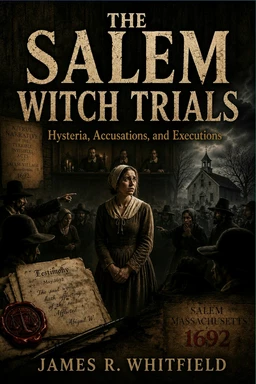
THE SALEM WITCH TRIALS
Hysteria, Accusations, and Executions The Dark Chapter of Colonial Massachusetts That Reveals How Fear and Superstition Can Tear a Community Apart
5,99 €