



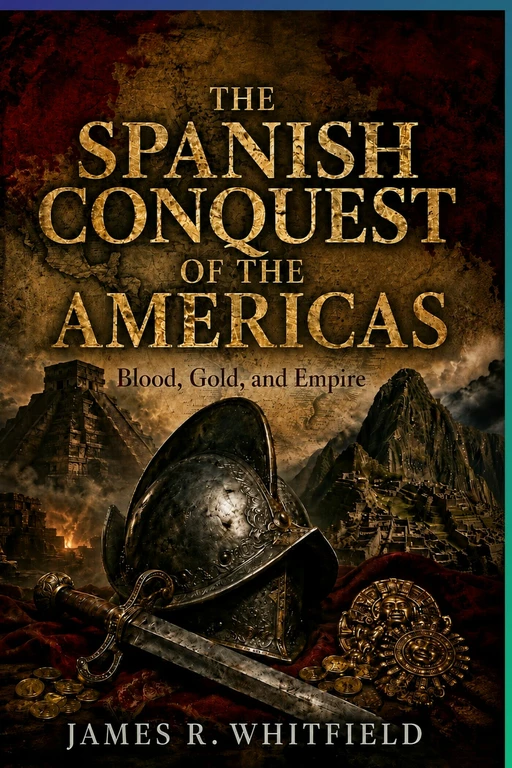
THE SPANISH CONQUEST OF THE AMERICAS
Résumé
In the spring of 1519, Tenochtitlán — capital of the Aztec Empire — was one of the largest cities on earth, with 200,000 to 300,000 inhabitants. London had perhaps 50,000. When Hernán Cortés arrived with approximately 530 men and had his ships scuttled in the harbor to foreclose retreat, he was committing to a campaign against an empire he could not yet fully imagine. Thirteen years later, Francisco Pizarro arrived in Peru with 168 men, captured the Inca emperor Atahualpa at Cajamarca, extracted a ransom room filled with gold and silver worth approximately the annual revenues of the Spanish Crown, and then executed him after a parodic trial.
This is the story of how those two conquests happened — and what made them possible. Historian James R. Whitfield traces both campaigns across twenty-one chapters, giving equal weight to Cortés, Pizarro, Moctezuma, Atahualpa, La Malinche, and Cuauhtémoc — whose defiant reply under torture, "Am I lying on a bed of roses?", is preserved in Bernal Díaz's chronicle. The book examines the Tlaxcalan alliance that provided 75,000 of the 80,000 warriors who destroyed Tenochtitlán, the smallpox epidemic that killed Aztec emperor Cuitláhuac within months of his accession, and the Inca civil war that had already split the empire before Pizarro arrived.
Inside this history of the Spanish conquest:• Cortés burns his ships — the legal trick that dissolved his subordination to Cuba's governor, and the 80-day siege that reduced Tenochtitlán to rubble (Chapters 5, 8)
• The Night of Sorrows — the catastrophic retreat of June 30, 1520, where Cortés lost half his force and most of Aztec gold in the lake causeways, then wept under a cypress tree at Popotla (Chapter 7)
• Cajamarca and the ransom room — 13,000 pounds of gold and 26,000 pounds of silver melted from Inca masterpieces, distributed among 168 men (Chapters 11-12)
• Steel, horses, and smallpox — why the obsidian macuahuitl could decapitate a horse yet still lost; the cocoliztli outbreaks of 1545-1548 that killed up to 15 million in central Mexico (Chapter 14)
• The Tlaxcalan alliance and its betrayal — 75,000 indigenous warriors who won the war for Spain, then had their promised privileges stripped within a generation (Chapter 15)
• The God Question — how the Requerimiento was read in Spanish to people who could not understand it, providing legal cover for wars Las Casas called monstrous crimes (Chapter 16)
The Spanish conquest of the Americas cannot be honestly celebrated; the human costs were enormous. But this narrative history of the Aztec and Inca empires resists the simplified prosecutorial version too — the actual record is more complicated than either the older heroic accounts or the recent rhetoric that replaced them. Every promise cites the manuscript. Every chapter treats Cortés, Pizarro, Moctezuma, and Cuauhtémoc as full historical actors whose decisions were made under their own constraints.
For readers of Charles Mann's 1491 and Hugh Thomas's CONQUEST: CORTES, MONTEZUMA, AND THE FALL OF OLD MEXICO.
Caractéristiques
Publication : 1 juin 2026
Intérieur : Noir & blanc
Support(s) : eBook [ePub]
Contenu(s) : ePub
Protection(s) : Aucune (ePub)
Taille(s) : 1,09 Mo (ePub)
Langue(s) : Anglais
EAN13 eBook [ePub] : 9798905165221
Avis
Ouvrages du même auteur
6,99 €
6,99 €

8,99 €
6,99 €
5,99 €