



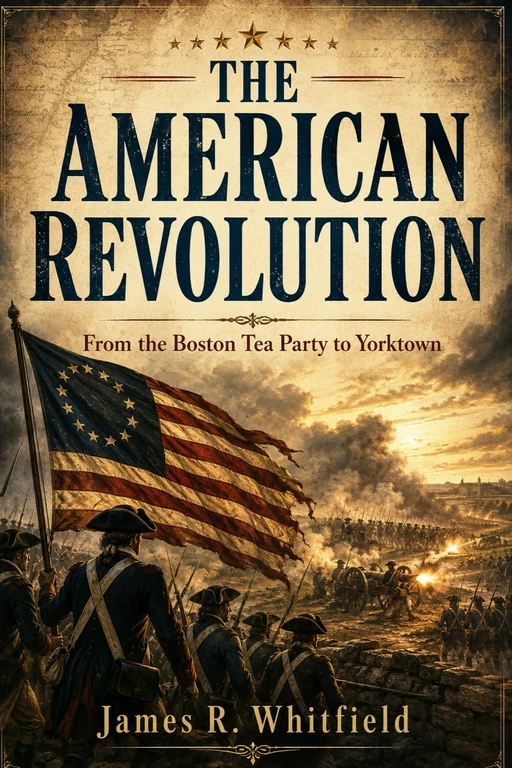
The american revolution
Résumé
On the night of April 18, 1775, Paul Revere and William Dawes rode to warn Massachusetts. By dawn at Lexington, eight militiamen were dead; at Concord, "the shot heard round the world" triggered a running battle back to Boston. Within a year, Congress voted independence. Eight years later, Cornwallis surrendered 7,000 men at Yorktown — and the greatest empire in the world conceded that thirteen colonies had become a nation.
This is the full story of how that happened — of George Washington, Nathanael Greene, Benedict Arnold, Daniel Morgan, the Marquis de Lafayette, John Adams, Benjamin Franklin, Thomas Jefferson, Alexander Hamilton, and Joseph Brant — across twenty-five chapters in seven parts. Historian James R. Whitfield traces the complete arc from Britain's 1763 debt crisis through Constitutional consolidation in 1789, integrating military, political, diplomatic, and social history in a single narrative that resists the old heroic simplifications.
Inside this American Revolution history:• The road to war — the Stamp Act crisis, Samuel Adams's committees of correspondence, the Boston Massacre of March 5, 1770 (John Adams defending the soldiers, five dead including Crispus Attucks), and 340 chests of tea dumped in Boston Harbor on December 16, 1773 (Chapters 1-3)
• Bunker Hill and the Continental Army — 1,054 British casualties in three assaults (a 44% casualty rate), Washington taking command at Cambridge on July 3, 1775, and Henry Knox hauling 60 cannons 300 miles from Fort Ticonderoga over winter terrain to force the British evacuation of Boston (Chapters 4-5)
• Valley Forge and Saratoga — the winter that forged a professional army, and the October 1777 victory that brought France into the war as a full military ally (Chapters 8-9)
• The southern war and the Swamp Fox — the Patriot-Loyalist guerrilla conflict in the Carolinas, Kings Mountain (290 Loyalists killed or captured in one hour), Cowpens (100 killed, 800 captured in a single engagement under Daniel Morgan), and Nathanael Greene's war of attrition that exhausted Cornwallis (Chapters 11, 13)
• Benedict Arnold's treason — the negotiations through Major John Andre, the plan to surrender West Point, Andre's arrest by three militiamen who found documents in his boot, and Arnold's escape to the British lines on September 25, 1780 (Chapter 12)
• The wider war — 20,000 to 100,000 enslaved Americans who escaped to British lines, the Loyalists who lost everything, Joseph Brant and the Native nations whose land the Revolution redistributed, and the women whose labor sustained the home front (Chapters 18-22)
The American Revolution was not inevitable. At every stage — from the Olive Branch Petition to the crossing of the Delaware to the diplomacy at Paris — it could have ended differently. Whitfield tells the story of how it actually unfolded: contingent, contested, and consequential beyond anything those who fought it could have anticipated.
For readers of David McCullough's 1776 and Rick Atkinson's THE BRITISH ARE COMING.
Caractéristiques
Publication : 2 juin 2026
Intérieur : Noir & blanc
Support(s) : eBook [ePub]
Contenu(s) : ePub
Protection(s) : Aucune (ePub)
Taille(s) : 1,17 Mo (ePub)
Langue(s) : Anglais
EAN13 eBook [ePub] : 9798905168475
Avis
Ouvrages du même auteur
6,99 €
6,99 €
6,99 €
6,99 €

5,99 €