



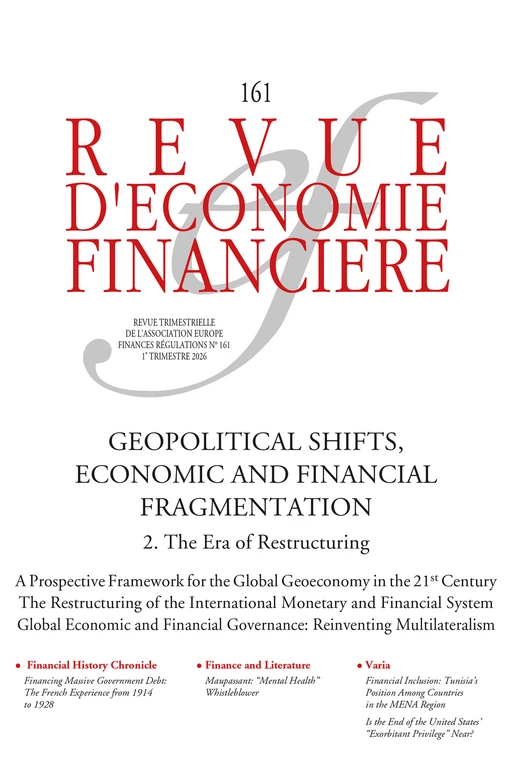
Geopolitical shifts, economic and financial fragmentation – Volume 2. The era of restructuring
Résumé
Under the co-direction of Bruno Cabrillac and Pierre Jaillet, issue 161 of the Revue d’économie financière is an extension of issue 160 on geopolitical shifts and their geoeconomic consequences. It is being published both in French and English.
The first volume (“The Era of Disruption”) analyzed the geoeconomic consequences of a systemic “polycrisis”, which has revealed the tensions arising from a phase of rapid globalization coupled with economic disruption. Issue 161 (“The Era of Restructuring”) examines the geoeconomic prospects of the new state of the world. Introduced by separate interviews with Enrico Letta and Arancha Gonzalez, it includes 13 articles, which have been divided into three chapters:
1. A prospective framework for the global geoeconomy in the 21st century
2. The restructuring of the international monetary and financial system
3. Global economic and financial governance: reinventing multilateralism
The role that Europe (and the euro) can and needs to play by stepping up its integration and by defending a broad set of international rules is a central theme of this volume.
The first chapter opens with an observation: based on the fundamentals, the United States could become more geoeconomically dominant in the coming decades. However, the policies implemented by the Trump administration - particularly on trade and immigration - could frustrate this dynamic.
The second chapter examines the restructuring of the international monetary and financial system. The evolving role of the dollar and of US assets - which could be bolstered by the development of stablecoins - is clearly at the heart of this restructuring. But the development of stablecoins could also destabilize US monetary policy and, beyond that, the international monetary system (IMS). So far, this restructuring has had limited consequences on international portfolio flows.
The third chapter begins with an assessment of the difficulties facing the multilateral order. Rules, institutions, and multilateral forums such as the G7 or the G20 have been compromised by the polycrisis situation and, above all, by Trump’s unilateralism. Even though multilateral cooperation has shown a certain resilience - for example, by preserving agreements on international taxation - it is no longer capable of meeting the challenges, particularly regarding the stewardship of global public goods. The obstacles to multilateral cooperation could be sidestepped, either through the coordination of policies less dependent on geopolitical choices - such as competition - or through coalitions of the willing involving non-state actors, as is being experimented with the COPs on climate and biodiversity.
Caractéristiques
Collection : Revue d'économie financière
Publication : 7 mai 2026
Édition : 1re édition
Intérieur : Noir & blanc
Support(s) : eBook [ePub + Mobipocket + WEB + PDF]
Contenu(s) : ePub, Mobipocket, WEB, PDF
Protection(s) : Marquage social (ePub), Marquage social (Mobipocket), DRM (WEB), Marquage social (PDF)
Taille(s) : 5,72 Mo (ePub), 10,8 Mo (Mobipocket), 1 octet (WEB), 2,83 Mo (PDF)
Langue(s) : Anglais
Code(s) CLIL : 3307
EAN13 eBook [ePub + Mobipocket + WEB + PDF] : 9782376471271
Avis
Ouvrages du même auteur
Enrico Letta, Arancha Gonzalez, Patrick Artus, Matteo Neri-Lainé, Hillel Rapoport, Jean-Pierre Maulny, Brad W. Setser, Arnaud Mehl, Isabel Vansteenkiste, Eric Monnet, Isabelle Mateos Y Lago, Pascal Saint-Amans, George Papaconstantinou, Jean Pisani-Ferry, Sébastien Treyer, Sylvie Goulard, Camille Maclet, François Chounet, Alain-Gérard Slama, Omar Gargouri, Michel Dupuy
26,99 €

George Papaconstantinou, Jean Pisani-Ferry
9,49 €

Enrico Letta, Élie Cohen, Nathalie Tocci, Delphine Deschaux-Dutard, Paul Wohrer, Itamar Rabinovich, Camille Mansour, Bernard Chappedelaine, Marc-Antoine Pérouse de Montclos, Sophie Perrot, Patrick Allard, John O'Rourke, Matthieu Tardis
17,99 €

15,99 €

8,49 €
Ouvrages de la même collection
Joachim Nagel, Anthony Saunders, Ingo Walter, Claudia Buch, Brunella Bruno, Elena Carletti, Lorenzo Bini Smaghi, Florian Heider, Jan Pieter Krahnen, Dominique Plihon, Andreas Bley, Daniel Quinten, Matthias Thiemann, Dorothea Schäfer, John Berrigan, Olivier Guersent, Marion Tosolini, Alain-Gérard Slama, Christian de Boissieu, François Villeroy de Galhau, Christian Pfister
26,99 €
Nicolas Baïetto, Thomas Fèvre, Pascal Brice, Hugues – Deniele, Hugues Deniele, Aurélien Létocart, Arnaud de Laguiche, Claire Carbonaro, Thomas Cassuto, Yvonne Muller, Robert Kuttner, Pierre de Lauzun, Laurence Barry, Emmanuel Picavet, Erwan Lamy, Horacio Ortiz, Erkki Liikanen, Lisa Warenski, David Bélanger, Léonore Brassard, Vaska Atta-Darkua, Robert F. Bruner, Scott C. Miller, Alain-Gérard Slama, Patrick Plane, Jacques Mazier, Pascal Petit
26,99 €
Enrico Letta, Arancha Gonzalez, Patrick Artus, Matteo Neri-Lainé, Hillel Rapoport, Jean-Pierre Maulny, Brad W. Setser, Arnaud Mehl, Isabel Vansteenkiste, Eric Monnet, Isabelle Mateos Y Lago, Pascal Saint-Amans, George Papaconstantinou, Jean Pisani-Ferry, Sébastien Treyer, Sylvie Goulard, Camille Maclet, François Chounet, Alain-Gérard Slama, Omar Gargouri, Michel Dupuy
26,99 €
Pascal Lamy, Sébastien Jean, Martial Foucault, Laurent Ferrara, Jamel Saadaoui, Alain Quinet, Dominique Plihon, Sylvie Matelly, Gilles Babinet, Matthieu Boussichas, André Lévy-Lang, Julien Pincet, Françoise Drumetz, Marc-Olivier Strauss-Kahn, Luiz Awazu Pereira Da Silva, Gaston Gelos, Costas Stephanou, Farley Grubb, Alain-Gérard Slama, Pierre Rondeau, Sarah Goldman, Maya Jandah
26,99 €
Pascal Lamy, Sébastien Jean, Martial Foucault, Laurent Ferrara, Jamel Saadaoui, Alain Quinet, Dominique Plihon, Sylvie Matelly, Gilles Babinet, Matthieu Boussichas, André Lévy-Lang, Julien Pincet, Françoise Drumetz, Marc-Olivier Strauss-Kahn, Luiz Awazu Pereira Da Silva, Gaston Gelos, Costas Stephanou, Farley Grubb, Alain-Gérard Slama, Pierre Rondeau, Sarah Goldman, Maya Jandah
26,99 €
Cédric Villani, Philippe Aghion, Antonin Bergeaud, Agnès Bénassy-Quéré, David Zhang, Xavier Boileau, Jean-Paul Mazoyer, Charles-Albert Lehalle, Thierry Foucault, Christophe Hurlin, Christophe Pérignon, Andrew W. Lo, Jillian Ross, Tobias Adrian, Benjamin Mosk, Jason Wu, Christine Balagué, Giulio Bagattini, Claudia Guagliano, Valentina Mejdahl, Iota Kaousar Nassr, Claude Diebolt, Alain-Gérard Slama, Jason Lermyte
26,99 €