


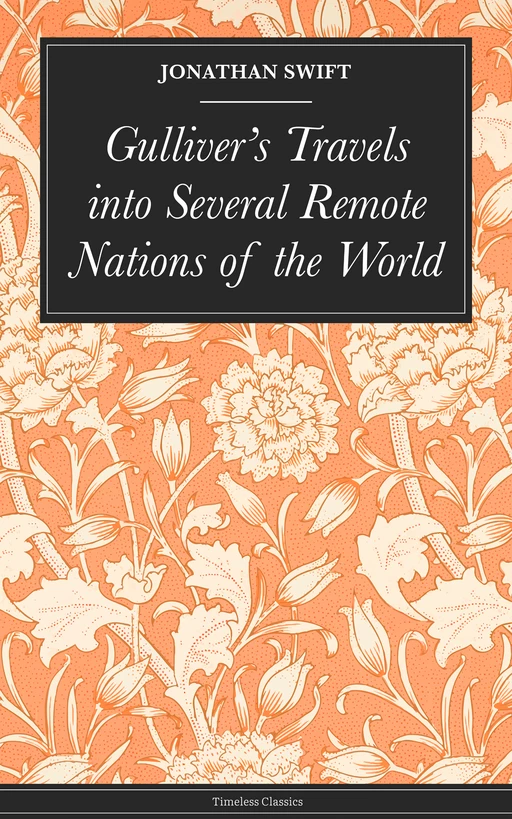
Gulliver's Travels into Several Remote Nations of the World
Résumé
Embark on a Satirical Voyage Through Imagination and Society with "Gulliver's Travels" by Jonathan SwiftDiscover the timeless classic that masterfully blends adventure, satire, and social critique in Jonathan Swift's "Gulliver's Travels." This captivating novel follows Lemuel Gulliver, a ship's surgeon, as he embarks on extraordinary journeys to distant lands, each more fantastical and thought-provoking than the last. From the tiny inhabitants of Lilliput to the towering giants of Brobdingnag, Swift's vivid descriptions and inventive worlds serve as a mirror to human nature, politics, and societal flaws. Through Gulliver's eyes, readers explore themes of power, corruption, and human folly, all wrapped in humor and wit. The book's clever satire offers a sharp commentary on 18th-century politics and human behavior, making it as relevant today as when it was first published in 1726. Swift's storytelling combines imaginative storytelling with incisive critique, inviting readers to reflect on the absurdities of their own world. Whether enjoyed as a fantastical adventure or a profound social critique, "Gulliver's Travels" remains a cornerstone of classic literature, inspiring countless adaptations and discussions. Dive into this literary masterpiece and experience a voyage that challenges perceptions and celebrates the enduring power of satire.Jonathan Swift (1667–1745) was an Irish satirist, essayist, political pamphleteer, and poet, renowned for his sharp wit and incisive social commentary. A master of satire, Swift's works often targeted the political and social issues of his time, earning him both admiration and controversy. His most famous works include "A Modest Proposal," "The Drapier's Letters," and "Gulliver's Travels," each showcasing his talent for blending humor with serious critique. Swift's influence extends beyond literature, shaping the development of satire and political thought. His keen observations and inventive storytelling continue to resonate, making him one of the most significant writers of the Enlightenment era.
Caractéristiques
Publication : 1 janvier 2026
Intérieur : Noir & blanc
Support(s) : eBook [ePub]
Contenu(s) : ePub
Protection(s) : Marquage social (ePub)
Taille(s) : 3,18 Mo (ePub)
Langue(s) : Anglais
Code(s) CLIL : 3436, 3444, 3446
EAN13 eBook [ePub] : 9782496770926