


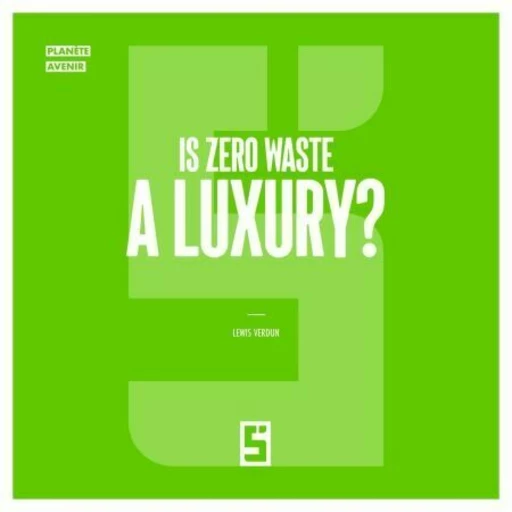
Is zero waste a luxury ?
Résumé
Zero waste is often presented as an ecological necessity : buying loose products, repairing, reusing, composting, avoiding plastic and limiting food waste. But behind this virtuous image lies a major social question : can everyone truly afford a zero-waste lifestyle ?
This concise and well-documented book examines the visible and invisible costs of everyday ecological transition : the price of durable alternatives, lack of time, small living spaces, unequal access to bulk shops, the complexity of sorting, the limits of recycling and the responsibility of industry. Drawing on recent data and reliable sources, it shows that zero waste cannot rely only on consumer goodwill.
Its added value is to move beyond individual guilt and offer an economic, social and collective reading of zero waste. The book highlights the conditions for a fairer model : accessible repair, deposit systems, reuse, source reduction, food-waste prevention and ambitious public policy.
This concise and well-documented book examines the visible and invisible costs of everyday ecological transition : the price of durable alternatives, lack of time, small living spaces, unequal access to bulk shops, the complexity of sorting, the limits of recycling and the responsibility of industry. Drawing on recent data and reliable sources, it shows that zero waste cannot rely only on consumer goodwill.
Its added value is to move beyond individual guilt and offer an economic, social and collective reading of zero waste. The book highlights the conditions for a fairer model : accessible repair, deposit systems, reuse, source reduction, food-waste prevention and ambitious public policy.
Caractéristiques
Collection : Planète Avenir
Publication : 8 octobre 2026
Intérieur : Noir & blanc
Support(s) : eBook [ePub]
Contenu(s) : ePub
Protection(s) : Marquage social (ePub)
Taille(s) : 120 ko (ePub)
Langue(s) : Anglais
Code(s) CLIL : 3310, 3337, 3406
EAN13 eBook [ePub] : 9791043419423