



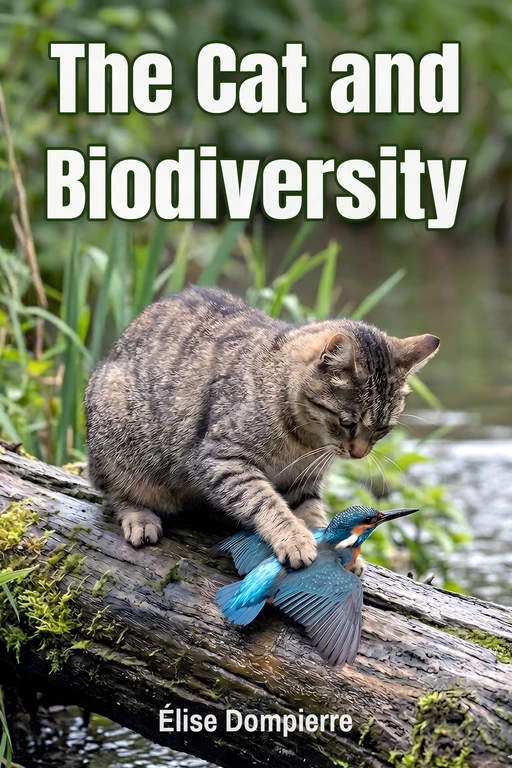
The Cat and Biodiversity
Résumé
It's on your lap.
It's purring.
When it goes outside, it kills.
The domestic cat is one of the most beloved animals in the world... and one of the most fearsome predators humans have ever spread across the planet.
In The Cat and Biodiversity, Élise Dompierre — a vegetarian who avoids contributing to animal suffering, and a cat lover herself — confronts a contradiction our societies often refuse to face head-on: how do we reconcile our unwavering love for our cats with the urgent need to protect biodiversity in peril?
This essay is structured like a fair trial in four acts.
1. The portrait of an extraordinary hunter
Equipped with hyper-developed senses and a killing technique wired into its genes, the domestic cat doesn't hunt out of hunger, but out of instinct. With a global population estimated at a billion individuals, this "killing machine" exerts unprecedented ecological pressure, one that goes largely unnoticed because it strikes mostly under cover of night.
2. The case for the prosecution: a heavy toll
The figures laid out in the second part are staggering. Every year, cats kill billions of wild animals worldwide: birds, lizards, shrews, amphibians.
Directly responsible for the extinction of at least 63 vertebrate species since the sixteenth century, the cat is a scourge for endemic wildlife, especially on islands. In Australia, where the feral cat is responsible for a genuine ecological catastrophe, it is classified as a pest species.
3. The defense: nuances and responsibilities
No trial would be complete without a defense. The third part reminds us that the cat is not solely to blame for the collapse of the living world. Set against habitat destruction and pesticides, it sometimes serves as a convenient scapegoat.
Above all, moral responsibility is refocused: the cat did not choose to be scattered across every continent; humans alone are responsible.
4. Toward responsible cohabitation
The fourth part offers concrete solutions. Élise Dompierre makes the case for a pragmatic approach: large-scale neutering, nighttime curfews, and turning our gardens into "sanctuaries" that offer refuge and corridors to local wildlife...
Can you love your cat and biodiversity? Yes, provided we act to ensure that our love for one doesn't mean death for the other.
You'll think back on this book every time you open the door for your cat...
The author, Elise Dompierre, describes herself as "a vegetarian whose love of cats gives her a few pangs of conscience!"
Caractéristiques
Collection : Science et nature
Publication : 8 août 2026
Édition : 1re édition
Intérieur : Noir & blanc
Support(s) : eBook [ePub + Mobipocket + WEB]
Contenu(s) : ePub, Mobipocket, WEB
Protection(s) : Aucune (ePub), Aucune (Mobipocket), DRM (WEB)
Taille(s) : 639 ko (ePub), 1,63 Mo (Mobipocket), 1 octet (WEB)
Langue(s) : Anglais
Code(s) CLIL : 3868, 3871, 3067
EAN13 eBook [ePub + Mobipocket + WEB] : 9782387620064
Avis
Ouvrages du même auteur
6,99 €
Ouvrages de la même collection
6,99 €