



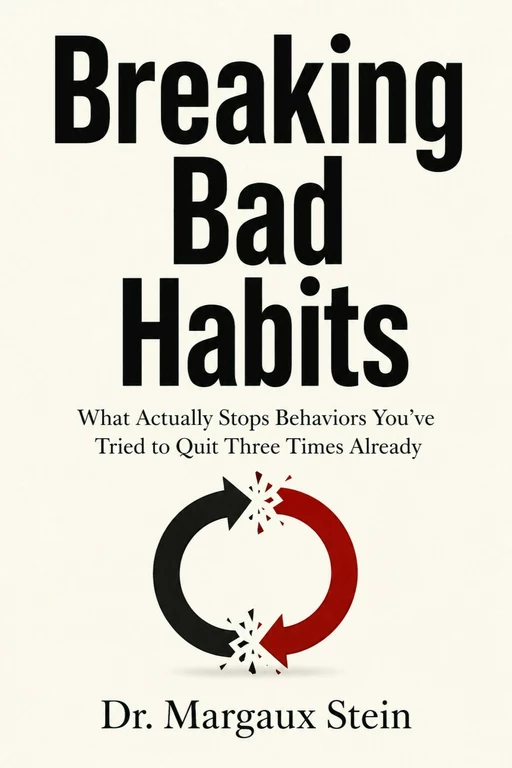
Breaking Bad Habits
Résumé
Breaking bad habits, stopping addictions, and changing behavior that willpower alone can't fix: a 25-year addictionpsychologist reveals what actually works — and why your previous quit attempts failed.READYIf you've tried to quit three times already and the habit is still running your life, the problem is not your character. In her first book forgeneral readers, Dr. Margaux Stein — an addiction psychologist with nearly twenty-five years of clinical practice — opens the wayshe opens every first session: "Nothing is wrong with you. Willpower isn't what stops habits. Trying to defeat them by deciding harderis like trying to stop a river by yelling at it." That single reframe, grounded in neuroscience, changes what you need to do next.Breaking Bad Habits is built on two things no other popular habit-change book combines: the general machinery of how any habitbecomes entrenched — cue-routine-reward loops, dopamine pathways, the basal ganglia, why relapse is data not failure — andhabit-specific chapters that go deeper than generic advice. Your phone is not your drinking. Drinking is not gambling. Gambling is notcompulsive shopping. This book covers all of them, in succession, telling you what is specifically tricky about each one and what tendsto actually work. The final chapters address the questions that arise no matter which habit brought you here: moderation versusabstinence, cold turkey versus tapering, how to involve other people, when a therapist or doctor is essential, how to design yourenvironment so the habit can't run, and what the quieter life on the other side actually looks like.Inside this habit-change and addiction recovery guide:Why willpower keeps failing you — the neuroscience of habits shows they live in a different brain system than decisions;fighting with effort is the wrong tool entirelyThe five gaps in cue-routine-reward — what the standard model misses: identity, context dependency, cumulative load, and thedual-process feedback that makes early sobriety cravings intensifyHabit-specific chapters on 11 behaviors — phone and screens, alcohol, food, nicotine and vaping, cannabis, pornography,gambling (including day-trading and crypto), compulsive shopping, overwork, lying, and procrastinationRelapse as data, not failure — how to debrief a lapse, patch the specific gap it revealed, and distinguish a single slip from anextended return to the patternEnvironmental design as the highest-leverage tool — room-by-room audits, digital friction strategies, financial environmentcontrols, and why this beats willpower around the clockThe first ninety days, specifically — a week-by-week account of what to expect so each phase doesn't feel like personal failure,including the deceptively dangerous second monthWhen to involve a clinician or medication — which substances require medical supervision before stopping, which medicationsare dramatically underused, and how to find low-cost helpWhether your habit is on the milder end — a phone scroll eating two hours of your evening — or closer to the addiction end of thespectrum, this book gives you the clarity that willpower never could: clarity about what your habit is doing for you, why your previousattempts didn't stick, which interventions match your specific behavior, and how to build a life the habit doesn't fit easily into. Mosthabit-change books treat every behavior with the same seven principles. This one doesn't, because your drinking isn't your gambling,and both deserve more than generic advice.For readers of Charles Duhigg's The Power of Habit and Annie Grace's This Naked Mind.--
Caractéristiques
Publication : 4 juin 2026
Intérieur : Noir & blanc
Support(s) : eBook [ePub]
Contenu(s) : ePub
Protection(s) : Aucune (ePub)
Taille(s) : 471 ko (ePub)
Langue(s) : Anglais
EAN13 eBook [ePub] : 9798905168765