



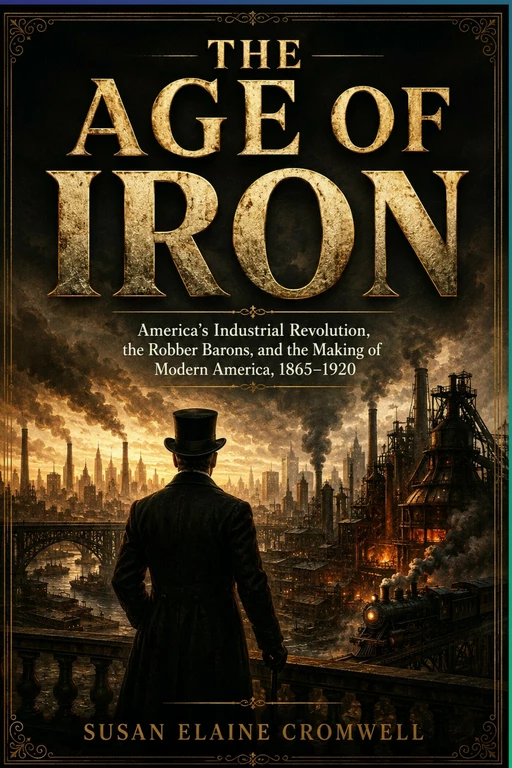
The age of iron
Résumé
The complete narrative history of America's Industrial Revolution — Carnegie, Rockefeller, J.P. Morgan, the robber barons, the factory workers, and the making of modern America, 1865-1920.In 1865, the United States was a nation of farms. By 1910, it produced more steel than Britain and Germany combined. Andrew Carnegie opened the Edgar Thomson Steel Works near Pittsburgh in 1875, hired Captain Bill Jones to drive production until it was the most efficient mill in the world, then sold the entire operation to J.P. Morgan in 1901 for $480 million — and spent his remaining years building 2,509 libraries while the workers who made his fortune labored twelve-hour days in mills where accidents killed by the hundreds each year.This is the story of that transformation — of Andrew Carnegie, John D. Rockefeller, J.P. Morgan, Jay Gould, Ida Tarbell, Samuel Gompers, and Eugene Debs — across twenty-four chapters in six parts. Historian Susan Elaine Cromwell traces the full arc of American industrialization from the Bessemer revolution through the Progressive regulatory response, covering the robber barons, the immigrant factory city, child labor, workplace disasters, and the antitrust tradition that still shapes American law.Inside this Industrial Revolution history:Carnegie's vertical integration — Mesabi Range ore, Great Lakes steamships, and connecting railroads giving Carnegie control from ore in the ground to finished rail on the loading dock (Chapter 1)Rockefeller's Standard Oil Trust — secret railroad rebates, the Cleveland Massacre that bought out 22 of 26 independent refineries in six weeks, and the 1882 trust controlling 90% of American refining (Chapters 2, 6)The railroad nation — 30,000 miles of track in 1860 growing to 163,000 by 1890, Chinese workers blasting through the Sierra Nevada with black powder, and the 1883 time zones that synchronized the nation's clocks (Chapter 3)The factory worker's world — twelve-hour days at 130-degree furnaces, an assumption-of-risk doctrine that blocked injury suits, and fifty-two years between the 1886 eight-hour demand and the 1938 Fair Labor Standards Act (Chapter 13)Workplace disasters — Monongah Mine, December 1907: 362 dead, the worst industrial accident in American history; Triangle Shirtwaist, March 1911: 146 young immigrant women dead in ten minutes (Chapter 16)The regulatory response — the Sherman Antitrust Act, Standard Oil's 1911 dissolution into 34 companies, and the Federal Reserve replacing J.P. Morgan's one-man financial rescues (Chapters 17-20)The robber barons delivered steel rails and kerosene at falling prices — and did so through methods that suppressed competition, exploited workers, and concentrated economic power in ways that democratic politics found intolerable. Cromwell delivers both sides of that ledger and the unfinished argument the industrial revolution bequeathed to every generation since.For readers of Ron Chernow's TITAN and T.J. Stiles's THE FIRST TYCOON.
Caractéristiques
Publication : 2 juin 2026
Intérieur : Noir & blanc
Support(s) : eBook [ePub]
Contenu(s) : ePub
Protection(s) : Aucune (ePub)
Taille(s) : 1,07 Mo (ePub)
Langue(s) : Anglais
EAN13 eBook [ePub] : 9798905168499