



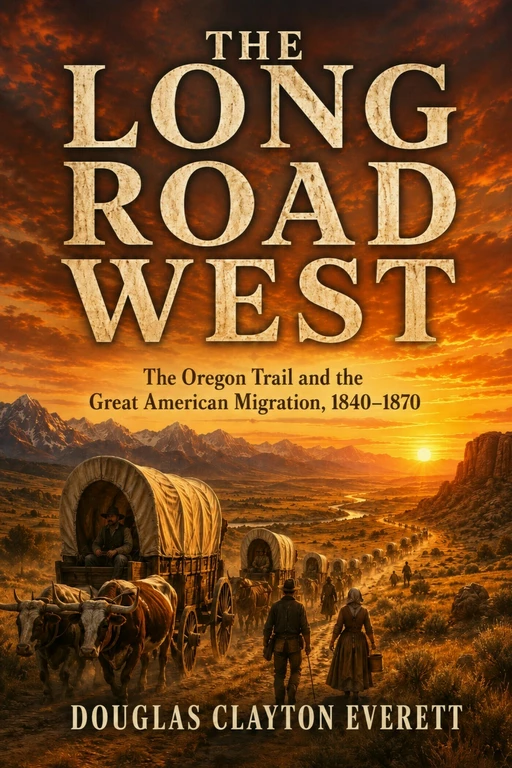
The Long Road West
Résumé
Oregon Trail history, westward expansion, overland migration — 300,000 emigrants, the Donner Party, Mormon handcart tragedies, and the Native peoples displaced by two thousand miles of ruts, 1840-1870.In the spring of 1843, approximately a thousand people gathered at the jumping-off towns — Independence, St. Joseph, Council Bluffs — and set out into an emptiness of two thousand miles. They were called the Great Migration, and they proved a wagon journey to Oregon was possible. Within a decade, 300,000 to 400,000 people had followed, leaving furniture and books behind at the Missouri River, watching cholera sweep through Platte River camps, and arriving — those who survived — in a Willamette Valley that promoter Hall Jackson Kelley had declared paradise without ever setting foot there.This is the complete narrative history of the overland trail era. Historian Douglas Clayton Everett traces the full arc across six parts and twenty-four chapters: the Oregon fever spreading through Illinois farm communities, the trail from Fort Laramie to South Pass, women's diaries recording reluctant migrations they had not been asked to make, and the Pawnee, Sioux, and Cayuse whose world the ruts were erasing. The Fort Laramie Treaty promised protection; the transcontinental railroad made the trail obsolete — what came between was the largest peacetime migration in American history.Inside this westward expansion history:Oregon fever and the 1843 Great Migration — Kelley's pamphlets, the thousand-person departure that proved the journey possible, and the community networks that transformed individual decisions into continental movement (Chapters 1-4)The Whitman mission and massacre — Narcissa and Marcus Whitman at Waiilatpu, the November 1847 killings that ended the mission era, and how Cayuse accountability customs collided with a measles epidemic (Chapter 2)Life on the trail — cholera on the Platte, women's diary accounts of grief at leaving parents forever, the specific equipment of the wagon, and the death toll that hundreds of diaries recorded (Chapters 9-12)The Donner Party — Hastings's misleading guidebook, James Clyman's ignored warning, three weeks hacking the Wasatch, the Forlorn Hope snowshoe party, and forty-eight survivors from eighty-seven (Chapter 19)The Mormon exodus — Brigham Young's 1847 pioneer company and the Willie and Martin handcart companies of 1856, whose 25-percent death rate was the worst single loss in trail history (Chapter 18)Native nations and the ecological reckoning — the Fort Laramie Treaty's broken promises, the trail's impact on the buffalo herds, and the Kalapuya dispossession behind every Willamette Valley farm (Chapters 13-16)Everett's overland trail history does not end at the Willamette. It follows the California forty-niners, the Applegate Trail's southern Oregon branch, and the Oregon Treaty's 49th-parallel settlement — then reckons with what was destroyed to build what was built. This westward expansion narrative is the most complete account of the trail era in print.For readers of Stephen Ambrose's UNDAUNTED COURAGE and David McCullough's THE PIONEERS.
Caractéristiques
Publication : 2 juin 2026
Intérieur : Noir & blanc
Support(s) : eBook [ePub]
Contenu(s) : ePub
Protection(s) : Aucune (ePub)
Taille(s) : 1,01 Mo (ePub)
Langue(s) : Anglais
EAN13 eBook [ePub] : 9798905165320