



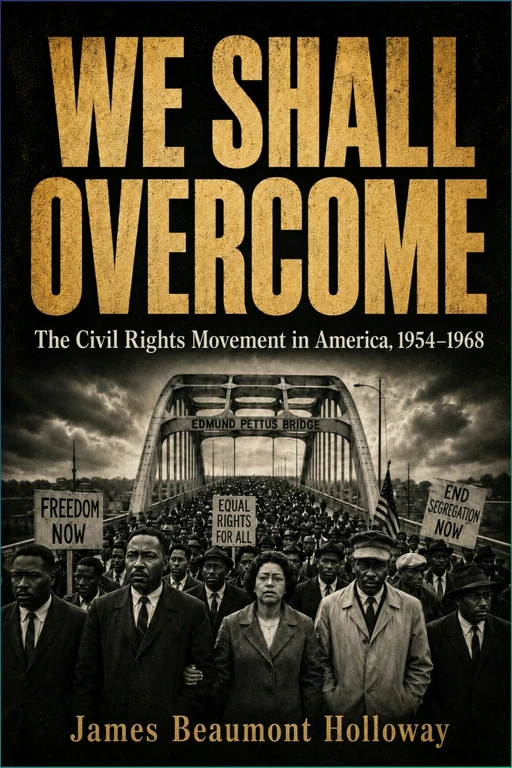
WE SHALL OVERCOME
Résumé
The complete civil rights movement history — Brown v. Board of Education, Rosa Parks, Martin Luther King Jr., the Civil Rights Act of 1964, Bloody Sunday, and the Voting Rights Act of 1965, across 24 chapters from 1865 to 1968.On December 5, 1955, Jo Ann Robinson — president of Montgomery's Women's Political Council — had already printed 52,000 overnight leaflets announcing a bus boycott. By evening, Black Montgomery had stayed off the buses almost entirely, a twenty-six-year-old minister named Martin Luther King Jr. had been voted the boycott's leader, and the Montgomery Improvement Association had voted to continue. The boycott lasted 381 days.This is the story of how a century of resistance dismantled legal segregation. Historian James Beaumont Holloway traces the full arc of the civil rights movement across six parts: Jim Crow's legal construction; the NAACP strategy that took Thurgood Marshall from Sweatt v. Painter to the unanimous Brown ruling of May 1954; the direct-action campaigns of Montgomery and Greensboro; Birmingham, the March on Washington, and the Civil Rights Act; the fractures of Black Power and King's murder in Memphis; and the unfinished reckoning the Kerner Commission named in 1968.Inside this civil rights history:Jim Crow's architecture — poll taxes, literacy tests, and 4,000 documented lynchings between 1877 and 1950, building a racial caste system designed to last (Chapters 1-4)The NAACP legal campaign — Charles Hamilton Houston's strategy from Gaines to Sweatt to McLaurin, and Kenneth Clark's doll studies that grounded the Brown v. Board ruling (Chapters 2-4)Montgomery — Rosa Parks as trained activist, 52,000 overnight leaflets, and 381 days of boycott establishing nonviolent mass action as the movement's method (Chapter 5)Birmingham and the Children's Crusade — Bull Connor's fire hoses and the photographs that forced Kennedy toward the Civil Rights Act of 1964 (Chapter 9)Bloody Sunday — John Lewis and 600 marchers beaten at the Edmund Pettus Bridge on March 7, 1965, and the weeks that produced the Voting Rights Act (Chapter 12)The unfinished revolution — the Kerner Commission's 1968 warning, persistent wealth gaps, mass incarceration, and the thread to George Floyd and 2020 (Chapters 21-24)The civil rights movement won the Civil Rights Act of 1964, the Voting Rights Act of 1965, and the Fair Housing Act of 1968 — and left work undone that continues today. Holloway's narrative African American history makes plain what was achieved, what it cost, and what the Kerner Commission knew would still need answering.For readers of Isabel Wilkerson's THE WARMTH OF OTHER SUNS and Taylor Branch's PARTING THE WATERS.
Caractéristiques
Publication : 1 juin 2026
Intérieur : Noir & blanc
Support(s) : eBook [ePub]
Contenu(s) : ePub
Protection(s) : Aucune (ePub)
Taille(s) : 1,07 Mo (ePub)
Langue(s) : Anglais
EAN13 eBook [ePub] : 9798905165153