



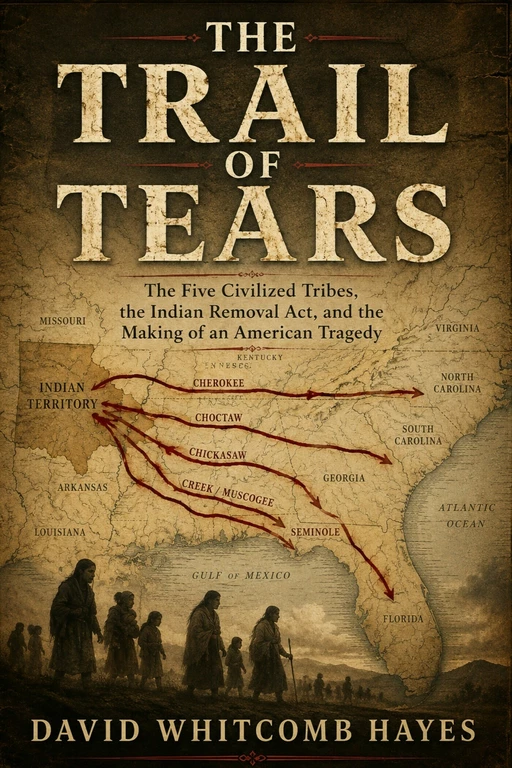
THE TRAIL OF TEARS
Résumé
Trail of Tears history — the Five Civilized Tribes, the Indian Removal Act of 1830, Andrew Jackson, and the complete narrative history of America's forced relocation of 60,000 indigenous people.Private John G. Burnett was twenty-eight years old in the autumn of 1838 when he supervised the Cherokee removal. He had grown up on the Tennessee-Georgia border and learned Cherokee as a boy. Sixty years later, dying at eighty, he wrote it down for his children: "Men working in the fields were arrested and driven to the stockades. Women were dragged from their homes by soldiers whose language they could not understand." He estimated four thousand died. "I fought through the Civil War and have seen men shot to pieces and slaughtered by thousands, but the Cherokee removal was the cruelest work I ever knew."This is the history of how that cruelty became federal policy. Historian David Whitcomb Hayes traces the Indian removal across twenty-four chapters — following Andrew Jackson, John Ross, Major Ridge, Senator Frelinghuysen, and General Winfield Scott through the political battles, Supreme Court victories that went unenforced, and the fraudulent Treaty of New Echota signed by only 500 of 17,000 Cherokee. The Choctaw walked first in the winter of 1831-1832 when Alexis de Tocqueville watched them cross the Mississippi: "misery and misfortune painted in such livid colors." They were followed by the Creek, Chickasaw, Seminole, and finally the Cherokee.Inside this American history of Indian removal:Georgia's assault on Cherokee sovereignty — the 1828 law voiding Cherokee courts, the gold rush that brought 10,000 prospectors to Dahlonega ($35 million extracted; the Cherokee received nothing), and the lottery distributing Cherokee land before removal was complete (Chapters 5-6)The Indian Removal Act of 1830 — passed by five votes in the House after Frelinghuysen asked "Do the obligations of justice change with the color of the skin?" and the 100,000-signature petition campaign (Chapter 6)Worcester v. Georgia — the Supreme Court ruling in the Cherokee's favor that Jackson refused to enforce (Chapter 10)John Ross's resistance — thirty-eight years defending Cherokee sovereignty; his wife Quatie died on the march after giving her blanket to a sick child (Chapter 7)The Choctaw template of failure — fraudulent food rations, blizzard conditions, estimated mortality of 12-28 percent of 21,000 people (Chapter 8)The Second Seminole War — the only removal the government could not complete, fought in the Florida swamps for seven years (Chapter 15)The Trail of Tears is not only a story of destruction. The Cherokee, Creek, Choctaw, Chickasaw, and Seminole nations maintained their governmental structures, cultural traditions, and political identity through nearly two centuries of continued pressure. Their descendants live in Indian Territory still. The road west ended at a destination from which there was no return — but it did not end the people.
Caractéristiques
Publication : 1 juin 2026
Intérieur : Noir & blanc
Support(s) : eBook [ePub]
Contenu(s) : ePub
Protection(s) : Aucune (ePub)
Taille(s) : 1,24 Mo (ePub)
Langue(s) : Anglais
EAN13 eBook [ePub] : 9798905165207