



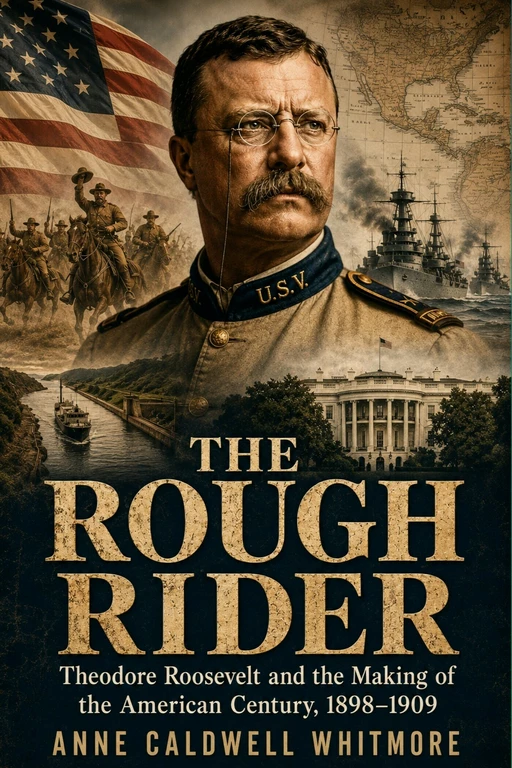
THE ROUGH RIDER
Résumé
The definitive narrative history of Theodore Roosevelt — trust-busting, the Panama Canal, 150 million acres of conservation, the Nobel Peace Prize, and the making of the American presidency, 1898-1909.On the night of February 14, 1884, Theodore Roosevelt drew a large X in his diary and wrote: "The light has gone out of my life." In eleven hours he had lost both his wife and his mother. He was twenty-five. What happened next revealed the man his father had made: Roosevelt finished the legislative session, arranged for his infant daughter to be raised by his sister, and rode west into the Dakota Badlands—into terrain that could kill the unprepared with cold, thirst, or simple disorientation—and rebuilt himself.Historian Anne Caldwell Whitmore follows Theodore Roosevelt from this defining moment of grief through eight years as the most consequential president between Lincoln and FDR. Across twenty-four chapters she traces how a sickly asthmatic child from a Manhattan brownstone—ordered by his father to build his body or watch his mind go to waste—became the man who busted the Northern Securities railroad trust, built the Panama Canal, mediated the Russo-Japanese War (winning the Nobel Peace Prize), and set aside more land for conservation than all previous presidents combined.Inside this Theodore Roosevelt biography:The Square Deal and trust-busting — how a $4.50 revolver elevated Roosevelt to the presidency at forty-two, and how he used the Sherman Antitrust Act against J.P. Morgan's Northern Securities railroad combine (Chapters 5-6)The Coal Strike of 1902 — the first time a president intervened in a labor dispute on behalf of workers, threatening to seize the mines if the operators refused arbitration (Chapter 7)Panama: taking the canal zone — an engineered revolution, seventy-two-hour diplomatic recognition, a $375 million construction project, and a workforce of 40,000 men that Roosevelt himself visited in 1906—the first president to leave the country while in office (Chapter 14)Conservation: 150 million acres — the Antiquities Act's presidential proclamation authority used to protect the Grand Canyon when Congress would not, and Roosevelt's night in Yosemite with John Muir, waking to snow under the Sierra Nevada stars (Chapters 11-12)The Portsmouth Peace — persuading Japan to drop its indemnity demand from Russia in exchange for territorial concessions neither side could publicly call defeat, earning the first Nobel Peace Prize won by an American (Chapter 15)The honest reckoning — the Brownsville affair's collective punishment of Black soldiers, the Filipino independence movement suppressed, and the imperial habits the Roosevelt Corollary established that Latin America would not forget (Chapters 13, 18, 24)Roosevelt left behind the regulatory state, the national parks, and an internationalist foreign policy the United States still operates within—alongside genuine failures in race and empire. Whitmore's Theodore Roosevelt biography holds both: the achievement and the cost, the energy and the blindness, the man who was the most alive person in any room he occupied.For readers of Doris Kearns Goodwin's THE BULLY PULPIT and Edmund Morris's THE RISE OF THEOD
Caractéristiques
Publication : 1 juin 2026
Intérieur : Noir & blanc
Support(s) : eBook [ePub]
Contenu(s) : ePub
Protection(s) : Aucune (ePub)
Taille(s) : 1,18 Mo (ePub)
Langue(s) : Anglais
EAN13 eBook [ePub] : 9798905165269