



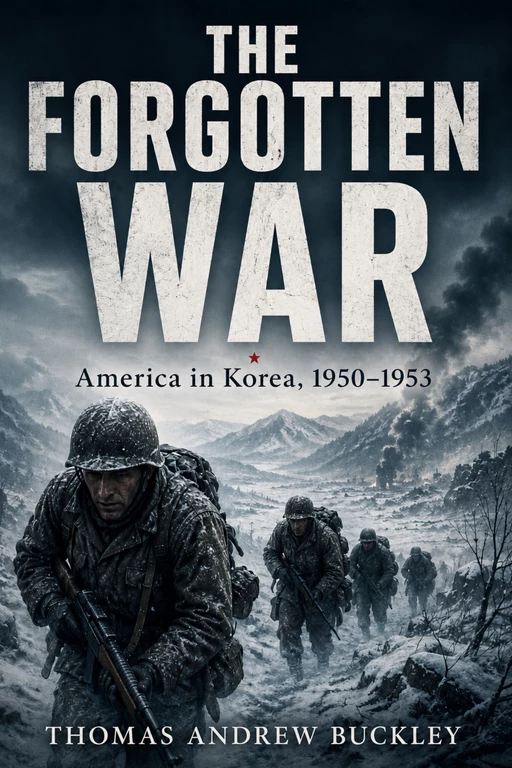
The Forgotten War
Résumé
Truman called it a police action. The phrase infuriated every soldier who fought it — and the 36,500 Americans who didn't come home. The Korean War was America's first limited conflict of the nuclear age, fought not for unconditional surrender but to restore a line on a map that two Army colonels had drawn in thirty minutes using a National Geographic atlas.Thomas Andrew Buckley traces the full arc across twenty-four chapters: Task Force Smith's disaster at Osan, where 540 men watched artillery shells bounce off Soviet T-34 tanks; the Pusan Perimeter's desperate last stand; and MacArthur's Inchon masterstroke — followed by the hubris that drove American forces to the Chinese border and brought 300,000 Chinese troops pouring across the Yalu in November 1950. Truman's firing of MacArthur for insubordination stands as one of the clearest affirmations of civilian control of the military in American history.The book restores what the standard narrative overlooks: Truman's Executive Order 9981 desegregating the military, tested under fire in Korea, and what Thurgood Marshall found when he investigated the disproportionate courts-martial of Black soldiers. The POW brainwashing controversy — including the 21 Americans who refused repatriation — gave rise to SERE training and the Code of Conduct that governs American prisoners of war to this day.The Korean War was forgotten not because it was shameful but because America had no category for a war that ended without victory. Buckley restores its true significance: the conflict that militarised NATO, rebuilt Japan's economy, desegregated the American military, and established the limited-war template the United States has followed ever since.
Caractéristiques
Publication : 30 mai 2026
Intérieur : Noir & blanc
Support(s) : eBook [ePub]
Contenu(s) : ePub
Protection(s) : Marquage social (ePub)
Taille(s) : 143 ko (ePub)
Langue(s) : Anglais
EAN13 eBook [ePub] : 9798905160325