



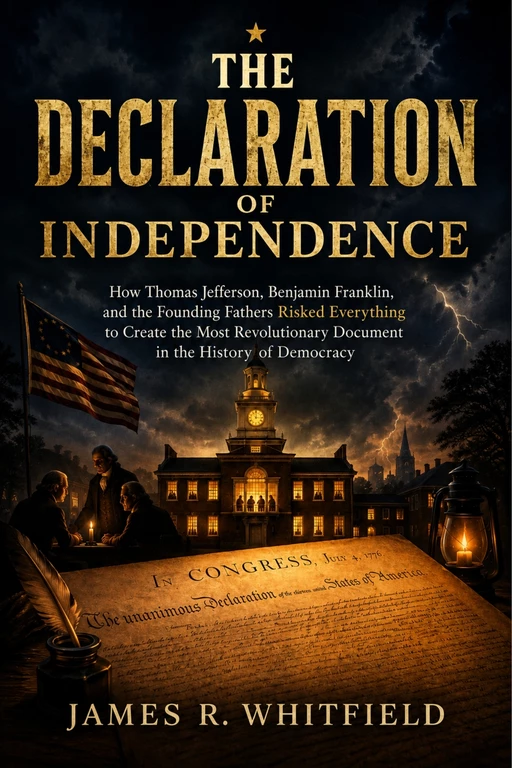
THE DECLARATION OF INDEPENDENCE
Résumé
In June 1776, Thomas Jefferson spent two weeks at a portable writing desk in a Philadelphia rented room, drawing on Locke, George Mason, and his own earlier writing to produce the draft that would become America's founding document. This history traces the full arc of that achievement — and the contradictions it carried from the start.The book covers the imperial crisis that made independence inevitable, Jefferson's drafting sprint, and the editorial hands that shaped the final text — including Benjamin Franklin's quiet change of "sacred and undeniable" to "self-evident." Four sweltering days of Congressional debate produced 90 revisions, most painfully the removal of Jefferson's slave trade passage under Southern pressure. The 56 signers risked execution and property seizure; some, like Richard Stockton of New Jersey, paid with their lives.The Declaration's most contested sentence — "all men are created equal" — is traced through its Lockean roots and its repeated redeployment by abolitionists, suffragists, and civil rights leaders across two centuries. Its global reach extended from the French Revolution to Latin American independence movements, the 1948 UN Universal Declaration, and Ho Chi Minh's 1945 Vietnamese proclamation.The book treats Jefferson's slaveholding directly, not as a footnote — the man who wrote that all men are created equal owned enslaved people his entire life. That contradiction is not incidental to the document's history. It is central to it.
Caractéristiques
Publication : 30 mai 2026
Intérieur : Noir & blanc
Support(s) : eBook [ePub]
Contenu(s) : ePub
Protection(s) : Marquage social (ePub)
Taille(s) : 133 ko (ePub)
Langue(s) : Anglais
EAN13 eBook [ePub] : 9798905160295
Avis
Ouvrages du même auteur
THE CALIFORNIA GOLD
RUSH From Sutter's Mill to Statehood
5,99 €
THE AMERICAN REVOLUTION
From the Boston Tea Party to Yorktown
7,99 €
CHRISTOPHER COLUMBUS
The True Story of the Explorer Who Changed the World His Voyages to the Americas, the Discovery of the New World, and the Controversial Legacy That Still Divides Us

6,99 €
GEORGE WASHINGTON
Soldier, Rebel, President The Remarkable Life of the Man Who Led the Revolution, Shaped the Constitution, and Became the Father of a New Nation
7,99 €
NATIVE AMERICAN HISTORY
From the First Migrations to the Modern Nations A Comprehensive History of the Original Inhabitants of North America
6,99 €