



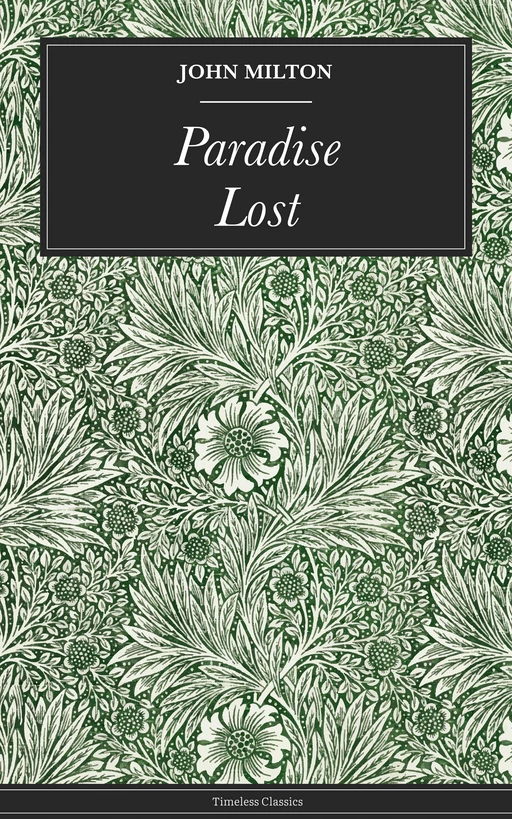
Paradise Lost
Résumé
Discover the Epic Battle Between Good and Evil in Milton's "Paradise Lost""Paradise Lost" by John Milton is a monumental epic that explores the profound themes of temptation, rebellion, and redemption. This timeless masterpiece vividly recounts the biblical story of the Fall of Man, depicting Satan's rebellion against God, the subsequent temptation of Adam and Eve, and their tragic expulsion from Eden. Milton's poetic brilliance brings to life the celestial battles, the complex characters, and the moral dilemmas that define human existence. Through rich imagery and profound philosophical insights, the poem examines the nature of free will, obedience, and the consequences of disobedience. As a cornerstone of English literature, "Paradise Lost" challenges readers to reflect on the eternal struggle between good and evil, divine justice, and human responsibility. Its influence extends beyond literature into theology, philosophy, and the arts, making it a vital work for understanding the human condition and the spiritual universe.John Milton (1608–1674) was a renowned English poet, polemicist, and civil servant, celebrated for his mastery of blank verse and his profound intellectual pursuits. A devout Puritan, Milton's writings often reflect his religious convictions and his advocacy for liberty and justice. His other notable works include "Areopagitica," a passionate defense of free speech, and "Samson Agonistes." Milton's life was marked by his unwavering commitment to his principles, even amidst political upheaval and personal hardship. His literary legacy endures as one of the greatest poets in the English language, whose works continue to inspire and challenge readers worldwide.
Caractéristiques
Publication : 1 janvier 2026
Intérieur : Noir & blanc
Support(s) : eBook [ePub]
Contenu(s) : ePub
Protection(s) : Marquage social (ePub)
Taille(s) : 3,02 Mo (ePub)
Langue(s) : Anglais
Code(s) CLIL : 3633, 3436, 3635
EAN13 eBook [ePub] : 9782496771558