



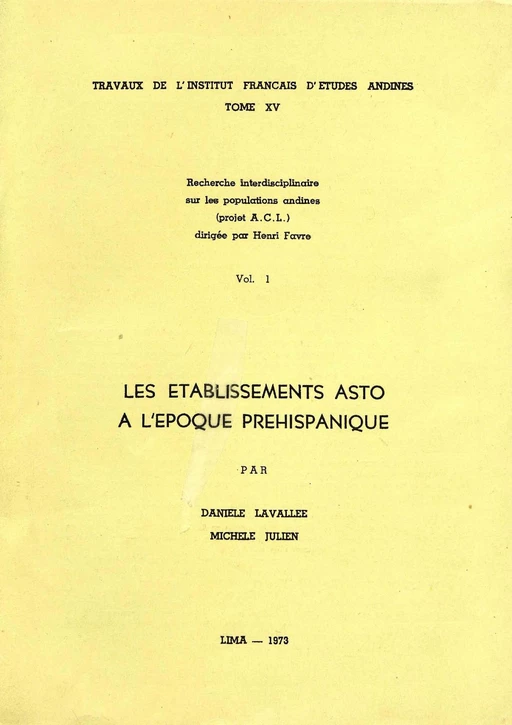
Les établissements Asto à l’époque préhispanique
Résumé
The aim of the A.C.L. Project was to study, through a multidisciplinary approach, the social organization and evolution up to now of three pre-Inca chiefdoms of the Central An-des cf Peru: the chiefdom of the Asto, and the adjacent Chunku and Laraw chiefdoms. A team of archaeologists, anthropologists, sociologists and geneticians belonging to the French National Center of Scientific Research realized the fieldwork from 1970 to 1972 according to a collectively built planning.In this project, the archaeologists' work was 1) to locate the immediately pre-Spanish settlements and study their spatial distribution, their insertion in the physical milieu and their internal disposition; 2) to reconstitute the social and economic structures by analysing the construction and the technical equipment; and 3) to situate chronologically and culturally the Asto and their neighbours among the pre-Spanish tribes of the Central Andes, and estimate the impact of the Inca presence within each of the three groups.The present publication deals with the Asto whose twenty-seven villages were located along the Vilca and Mantaro valleys. The collected ceramics prove that all of them belong to the Late Intermediate Period. C14 dating indicates that some were occupied from the be-ginning of the XIth century AD. Therefore, the duration of the Asto occupancy would be of five hundred years. During the XVth century the Asto were conquered by the Inca and incorporated to their empire. The Asto villages were still in activity when the Spaniards arrived.The altitude of the villages ranges from 3 100 to 4 500 m above sea level (52% from 3 500 to 3 900 m). In all cases the settlement pattern is the same: it is based on aggregattes of circular edifices built on top of naturally well-protected mountains. The choice of such fortified sites obliged the Asto to concentrate the buildings within limited areas according to two types adapted to the declivity of the land: 1) the "joined alveolar" type (soft slope), and 2) the "terrace alveolar" type (ground steeper slope). In both cases, the basic element is the "alveolar unit", an aggregate of circular buildings of variable importance (from two to twelve buildings), clustered around a central yard, that probably constituted a family residence. To verify this hypothesis and determine the function of each building of the alveolar unit, we have analysed in detail the archaeological content of the floors and studied the numerous kinds of remains found on the ground. Their differential repartition reflects at the same time the organization of the areas of activity, the technical equipment, and the products of general use and consume.The analysis of organic remains reveals the presence of maize and quinoa as for cultivated species, and of lamas or alpacas (domesticated), vicuñas, tarucas, fowls and dogs as for edible animals. One of the most important results of the pollen analysis is to established that, at the same altitude, the agricultural potential of the soil is more reduced today than during the pre-Spanish period. The floor of all excavated buildings contains an important quantity of fragments (1 000 or more) of vessels (40 or 50) of different types such as jars, cooking pots, dishes, spoons. Lithic tools have been found in all the buildings: cultivating, harvesting and grinding implements, hammers, knives and scrapers, etc.Finally, it seems that each building fulfilled in turn the functions corresponding to the various sectors of everyday activity (kitchen, dwelling, grancry). The complexity of the levels found, can be explained by the "long life" of the buildings. They were successively abandoned and re-occupied for different uses, due to the exiguity of the available land which impeded the village's territorial extension and obliged to re-utilize permanently the same spaces.Keeping these data in mind, it is possible to evaluate in a few cases the population of the villages. Considering there were 5/6 persons...
Caractéristiques
Collection : Travaux de l'IFEA
Publication : 20 mai 2014
Intérieur : Noir & blanc
Support(s) : eBook [PDF + ePub + Mobipocket + WEB]
Contenu(s) : PDF, ePub, Mobipocket, WEB
Protection(s) : Marquage social (PDF), Marquage social (ePub), Marquage social (Mobipocket), DRM (WEB)
Taille(s) : 3,95 Mo (PDF), 5,29 Mo (ePub), 4,41 Mo (Mobipocket), 1 octet (WEB)
Langue(s) : Français
Code(s) CLIL : 3081
EAN13 eBook [PDF + ePub + Mobipocket + WEB] : 9782821845220
Avis
Ouvrages du même auteur
10,99 €
22,99 €
Ouvrages de la même collection
10,99 €
19,99 €
5,99 €
17,99 €