



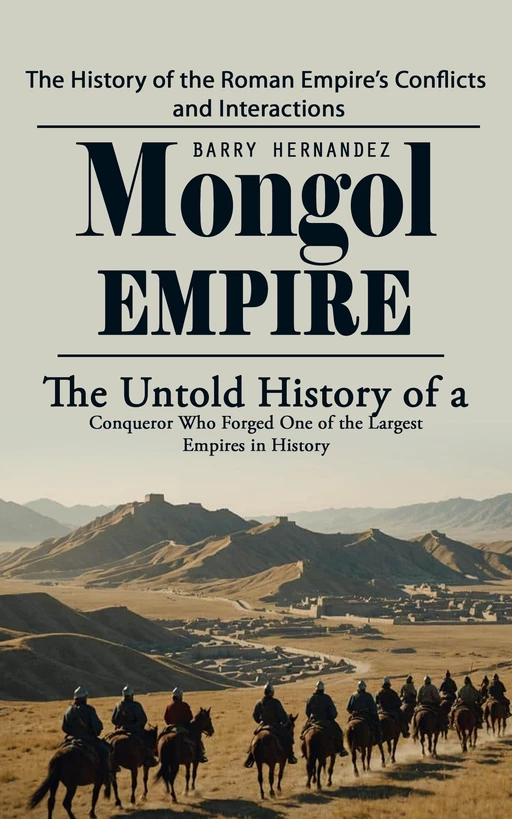
Mongol Empire: The History of the Roman Empire’s Conflicts and Interactions (The Untold History of a Conqueror Who Forged One of the Largest Empires in History)
Résumé
The mongols were innovative and creative in everything they did beyond just warfare. They owed their successes to their military tactics and impressive art of war, which relied heavily on incredible horsemanship, archery, and other fighting skills. But they also created an immersive world full of ideas, inventions, and art.The mongolian empire was a state built by folks who knew how to keep up with the times. The mongols put to use many ideas and technologies of the day and were very much capable of making these things work for them.You’ll discover:•Genghis khan’s rise—from outcast temujin to empire-builder.•Revolutionary warfare—tactics, technologies, and strategies that stunned enemies.•Empire management—administration, law, and communication across vast distances.•Innovation & adaptation—from siege warfare to trade networks.•Cultural impact—how mongol rule reshaped art, commerce, and knowledge exchange.•Decline & legacy—why the empire fell and what remains of its influence today.Genghis khan was a leader that was ruthless in his aims and ambitions, a man who thought nothing of destroying everything in his path. His reputation of extreme brutality sent villagers running from their homes when they got even a hint that genghis khan was coming their way. But is that the entire story? Was he as bad as history has made him out to be?This was an individual who established an empire that survived for more than a century after his demise, and it did so to such an extent that it was the longest continual empire to have ever been created in the history of the world. A wonderful battlefield commander, a prime tactician, he had a need to conquer the world that shaped this man into a fearless leader that would ultimately go on to shape what we now know as the modern world.
Caractéristiques
Publication : 3 janvier 2026
Intérieur : Noir & blanc
Support(s) : eBook [ePub]
Contenu(s) : ePub
Protection(s) : Marquage social (ePub)
Taille(s) : 758 ko (ePub)
Langue(s) : Anglais
EAN13 eBook [ePub] : 9798902161448